 Nishant Ahlawat
OKR Meaning Explained: What Is an OKR? Definition, Types & Examples
Most teams are not short of work; they are short of clarity. I have […]
This has happened in most cases where one gets an extra amount of money as an incentive and experiences the feeling of excitement, but over time, starts operating with the same level of motivation.
This does not mean that financial incentives fail to achieve their purpose. They do! However, after my analysis of how rewards impact employee performance, it has become evident that money is effective when combined with motivation techniques.
For instance, according to the 2026 State of the Global Workplace report by Gallup, only 20% of workers were engaged in 2025; therefore, it explains the need for organizations to reconsider how to offer incentives and make the whole process of rewarding employees more than just an activity, but a holistic performance process.
There are specific elements that help incentives perform better in terms of boosting employees’ productivity. In this regard, the elements include transparency, fairness, visibility, and alignment.
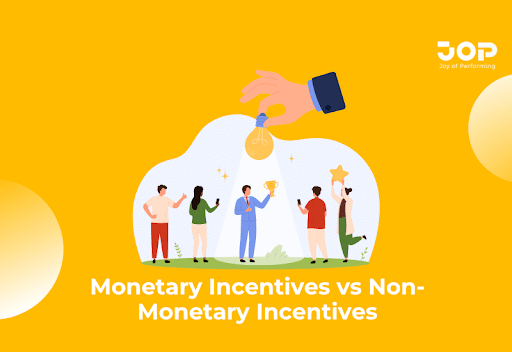
A monetary incentive is a financial award provided to the staff as an encouragement to meet certain goals, demonstrate excellent results in their work, or make some contribution to organizational achievements.
In plain language, these are awards based on financial gain. Such rewards can include bonuses, commissions, incentive payments, performance awards, or any other financial benefits.
The primary goal is obvious: to motivate employees to work harder, meet their objectives, and concentrate on concrete accomplishments.
For instance, salespeople may provide a straightforward connection between performance and remuneration, as such employees know the requirements to be met in order to get extra pay.
At the same time, it will be effective only under one condition – when employees have sufficient information about how the award is to be computed and how fairly it was received.
These are used by organizations in several ways to motivate their employees. Examples of the most frequently used include:
Performance bonuses are paid upon achievement or outperformance of pre-set goals. They may be monthly, quarterly, or yearly, depending on the organization’s reward scheme.
Sales commissions are among the most frequently employed for sales staff. These incentives plans are tied to a fixed sum or a percentage of sales, completed deals, etc.
Incentive payments are awarded in cases of achievement of certain organizational goals, including monthly sales quotas, collection improvement, productivity boost, project accomplishment, etc.
Through profit-sharing schemes, employees receive some portion of profits made by the company. This is helpful in terms of making them feel involved in company affairs.
Spontaneous rewards include immediate cash bonuses for excellent performance, fast problem-solving, and exceeding job responsibilities.
Retention bonuses are awarded to convince important personnel to remain within the organization for a certain duration, particularly during periods of transition or critical importance to the business.
Salaries can be used as incentives, especially when tied to performance, contributions, and progress made.
With proper application, these allow employees to know their goals and achievements and what rewards await them for their successes.
Money incentives are powerful motivators in the short term, particularly where there are clear and measurable time-bound objectives.
A good illustration is the sales function, where an incentive scheme can help to spur urgency, drive focus, and motivate people to achieve their monthly or quarterly objectives. Such incentives are helpful in motivating employees to meet certain objectives, such as making more sales, better collections, greater efficiency, and better field force accountability.
In the long run, money incentives are insufficient motivators for sustaining employee engagement. Besides being appreciated, workers require recognition, career development, management support, and purpose.
This explains why financial incentives are ideal as performance enhancers.
Non-monetary rewards include the types of incentives that do not directly pay money but satisfy employees’ emotional, professional, or social desires.
They include incentives based on gratitude, development, freedom, recognition, knowledge, independence, and work experience.
In other words, non-monetary incentives help employees feel appreciated, trusted, respected, and supported.
If a monetary reward gives an answer to the question “How much money will I receive in case of good performance?” then a non-monetary reward helps find the answer to another question, “Am I appreciated here?”. The latter is a very important point.
Non-material rewards may seem insignificant, yet if provided systematically, they can produce a significant effect on the level of motivation in the organization.
Recognition is a powerful means to encourage and motivate employees. To be effective, the manager should recognize particular achievements or performance and provide it at an appropriate moment.
When a promotion opportunity exists, employees feel more motivated since they see a career perspective and feel rewarded for their work.
Learning and development are great non-financial motivators. They signal that the company values its employees’ efforts and supports their development.
Work flexibility is a great way to boost employees’ engagement, make them feel like owners of their projects, and increase work-life balance.
The employees will be more inspired when they know what purpose their job serves in relation to the overall objectives of the company. It is easier for people to be engaged in their tasks when they see the consequences of their labor.
People need to have a sense of responsibility toward what they do. It gives a chance to make better decisions and take responsibility.
In many cases, managerial encouragement proves more effective than occasional rewards. Employees appreciate support, care, and appreciation from their supervisors.
| Basis | Monetary Incentives | Non-Monetary Incentives |
| Meaning | Reimbursements offered for good work or performance | Reward types that encourage by means of recognition, development, trust, and experience |
| Examples | Performance bonuses, commission, incentive payments, profit sharing, and pay rises | Recognition, flexibility, learning, development, appreciation, and empowerment |
| Best For | Improvement in short-term performance, target attainment, sales, and increased production efficiency | Engagement and loyalty, culture creation, and increased satisfaction with the job |
| Impact | Produce motivation immediately and drive performance | Establishes an emotional connection and motivation in the long run |
| Risk | Risk of becoming transactional without good design | Appear to lack strength if fair pay and clear performance criteria are lacking |
| Works Best When | Clear goals, targets, and rules regarding payouts | Recognition and development opportunities are consistent and meaningful |
The real solution does not lie in choosing between the two; rather, it lies in using both.
The former motivates workers to concentrate on their performance through financial benefits. The latter motivates workers to have an emotional attachment to the working environment.
Both work hand in hand in achieving the best reward system.
For instance, a salesperson can be motivated by a bonus payment per month. However, if he/she gets constructive feedback, good relations with the sales manager, and visibility among others, the motivation is greatly enhanced.
In summary, after conducting research and analyzing how incentives work within organizations, I can clearly state that monetary incentives are effective, but they require a proper framework.
Employees should be aware of how incentives will be calculated, which means there should not be any ambiguity regarding the calculation process. On the other hand, management should not struggle to analyze different pieces of sales data in order to find out who is performing well, who has fallen below the required run rate, and where intervention needs to be made.
It is for this reason that platforms such as JOP Edge may come in handy.
Through JOP Edge, big sales teams may get visibility about the actual performance, target, run rate, incentives, and risks. The platform can enable leaders and management to transition from unstructured sales data to performance action.
Thus, while incentives play a key role in motivating employees, their true value lies in being transparent, visible, and actionable by managers.
In other words, incentives should not only reward performance but also enhance performance as well.


Monetary incentives are financial rewards given to employees for achieving specific goals, improving performance, or contributing to business results. These can include bonuses, commissions, incentive payments, salary increments, and profit-sharing.

