7 Best Performance Management Software for Small Business
 Nishant Ahlawat
On this page
Running a small business? Finding the right performance management software shouldn’t feel like a burden but bliss, so here we’ve rounded up the 7 best tools to help you boost productivity, keep your team on track, and grow with confidence.
In this blog, we’ll deep dive into the best performance management software for small businesses, which will help your bold visions align with the team’s spirit.
What is Performance Management Software?
Performance management software is a tool that HR and managers use to track, evaluate, and improve employee performance, aligning it with organizational goals. Instead of relying on once-a-year performance reviews, it offers real-time tracking, goal setting, and ongoing feedback.
These systems provide support and insight that annual reviews simply can’t. With built-in analytics and goal tracking, managers can quickly spot deep trenches and support employee development in a way that feels very relevant.
It’s just about helping people to thrive, not once, but in a streak.
How We Evaluated and Selected the Best Performance Management Software for Small Businesses
Don’t worry, we’ve got you covered. We based about two-thirds of our evaluation on real user reviews from the past year across platforms like G2, Capterra, and Trustpilot.
These are the key points you must consider while selecting a software that meets your needs:
- Core Features that support growth
Some tools are built specifically for performance management and reviews, while others offer additional features like goal-setting, time tracking, pulse surveys, employee engagement tools, and recognition systems. These tools not just manage but also help small businesses to experience a kickstart. - Ease of Use
For everyone, ease of use is a must. We prioritized platforms with clean interfaces that are simple to set up so that you can get started without any delay or tech support. - Built to fit your way of working
Flexibility matters, trust me. We looked for tools that genuinely let users customize performance review templates, workflows, and reports to fit their specific needs. This is how you’ll make the system work for you, not the other way round. - Analytics & Reporting
Strong reporting is essential. The best tools provide detailed, easy-to-understand performance insights to help guide better decision-making. It’s about turning strong data into visible outcomes. - Integration Capabilities
The last thing you need is the tool that integrates easily and creates silos. We gave preference to software that plays well with other tools that integrate with the systems you’re already using to keep everything connected and streamlined.
Overview of 7 Best Performance Management Softwares
Choosing the right performance management software can feel overwhelming at the moment, but it doesn’t have to be. We’ve done the heavy lifting by breaking down the pros, cons, and key features of each tool.
| Software | Best For | Pricing Details | Key Features |
|---|---|---|---|
| JOP (Joy of Performing) | Enables real-time performance insights with regular check-ins, updates, and progress tracking. |
|
|
| BambooHR | Small to midsize businesses seeking user-friendly HR solutions | Basic HR tools + time-off: $6–7/user/month |
|
| Gusto | Small businesses seeking integrated payroll and performance management | Base fee: $40/month |
|
| Paycom | Midsize to large organizations requiring comprehensive HR solutions | Typically $24–$36 per employee/month |
|
| Workday | Large enterprises needing scalable HCM and performance management | Base fees generally fall between $50–$150/user/month |
|
| Zoho People | SMBs looking for customizable and affordable HR software | Essential HR plan: $1.25/user/month |
|
| Lattice | Create personalized growth paths, career development frameworks, and track progress with role clarity and promotion readiness tools | Base cost: $10/employee/month |
|
So, whether you’re looking to streamline feedback, track goals, or boost team performance, you’ll have all the insights you need to pick the one that works best for your small business.
1. JOP (Joy of Performing)
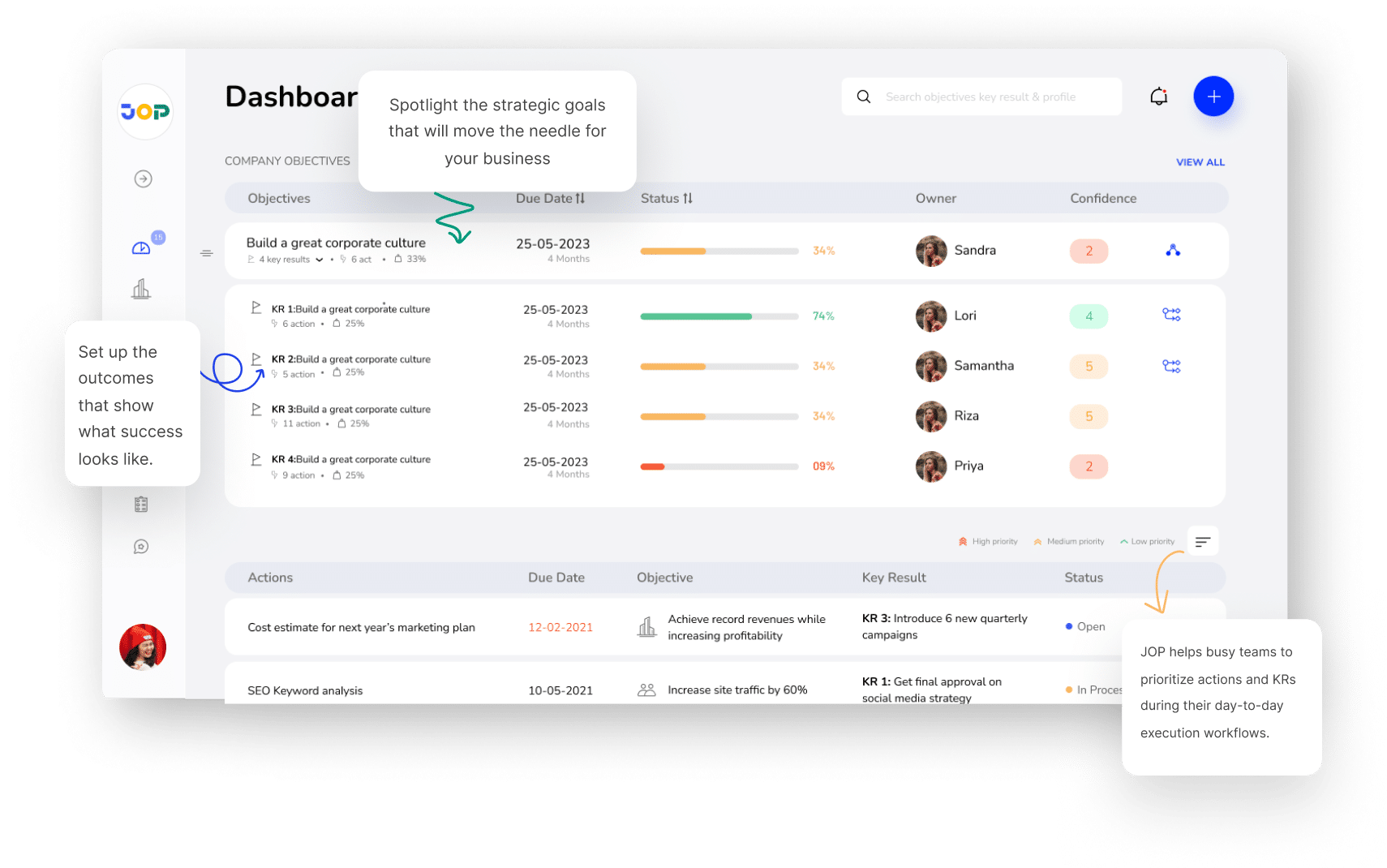
JOP (Joy of Performing) is not just a software but a revolution for small businesses. By focusing on creating a positive work environment, JOP celebrates a people-first culture where employees feel motivated to work and serve. Through its very creative features, such as personalized performance plans, gamified recognition, and seamless integration with other HR functions, JOP makes everything easier while keeping the team cooperative and happy.
Key features of JOP:
- Personalized plans for every fellow
- A gamified recognition system to counter boredom
- Innovative OKR visuals in a constellation format
- Analytics to ease performance tracking and decision-making
Pros
- Well-crafted performance management plans for each employee
- A gamified recognition system, definitely not a boring management software
- Integration with various HR functions
- Analytics, very important for data-driven decision-making
- OKR data visualization in a super cool constellation format for easy progress tracking
Cons
- Fresh starters unfamiliar with OKRs or continuous performance management may need some time to learn the system, but trust me, it is worth it.
JOP Pricing
2. BambooHR

BambooHR is a cloud-based HR performance management software made for small and mid-sized businesses with an easy-to-use interface, making it a cup of tea for teams to manage everything from onboarding to offboarding without HR interference.
Key features:
Self-service portal for hassle-free employee management
Simple onboarding and offboarding processes
Integrated time tracking, keeping punctuality in habit
Performance management tools for setting and reviewing goals
Pros
- User-friendly interface that just makes sense
- Strongly focuses on employee self-service
Cons
- Limited reporting capabilities
- It May not be suitable for large enterprises with complex HR needs
- Limited integrations with other HR systems
- Lack of advanced features, can’t keep pace with technology
3. Gusto
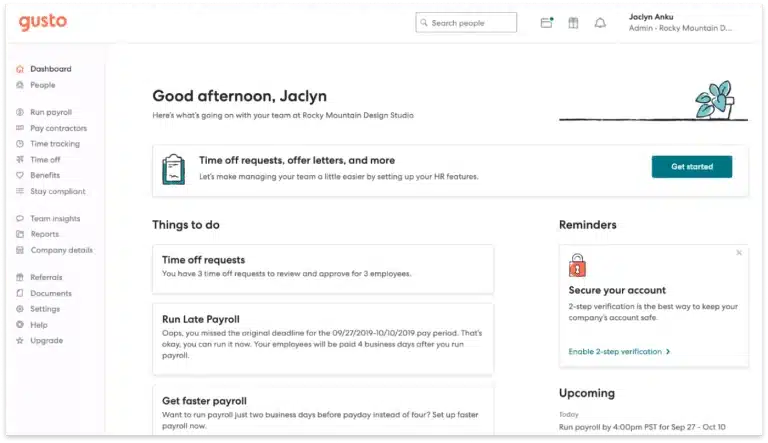
Gusto is a go-to platform designed for small businesses looking for a simple yet innovative way to deal with HR bustle and easily handle payroll. It is built to relieve admin tasks, shifting the whole agenda to success and goals rather than management responsibility. Gusto is armed with a wide range of features, including payroll processing, benefits administration, and time tracking.
Key features:
Easy payroll processing with data-based decisions
Benefits administration for health insurance and retirement plans
Cool Onboarding tools for new joiners
Integrated time tracking system, punctuality is a necessity
Pros
- Simplified payroll processing
- Affordable pricing, that's what we need
- Easy onboarding process, a breeze
Cons
- Limited self-service resources hinder users from seeking instant solutions.
- Lack of transparency in the product roadmap
- Features may not effectively scale for mid-market companies with diverse HR needs.
- Lacks advanced features required by large enterprises.
4. Paycom

Paycom is ready to use an HR and payroll solution that offers a range of features, including time and attendance tracking, benefit administration, and employee self-service. With its focus on automation and efficiency, Paycom can help businesses get it done without any manual efforts. Revolutionalizing tech, not paperwork.
Key features:
Payroll and HR functions
Time tracking for attendance management
Employee self-service access, to avoid loss of data
Benefits administration for managing employee benefits with crystal clear metrics